
Why Systems Are Stronger Than Tools
Case Date: Fall 2020
Before
Custom Concrete's dirt and stone operation ran on paper tickets. Every residential project starts with excavation, dirt hauling, and a #2 stone construction drive. The process relied on people writing data down right, the ticket actually reaching the office, and the same information getting recaptured by different hands at different points in the billing cycle. The department’s billing data began its life on a slip of paper in a dump truck, easy to lose, easy to pin to the wrong job, easy to delay. The first record of money the company was owed was its least reliable one.
With hundreds of tickets a month, even a small error rate was a constant leak. Supplier invoices were difficult to reconcile. A stone ticket that slid under a driver's seat surfaced only after the customer had already been billed, too late to recover. Custom sometimes ate the cost, and revenue it had already earned quietly became a loss.
None of it was anyone's fault. It was just the way it had always
After
Today Custom runs on a different system entirely. Field Logistix has been in production since 2019, and the data is captured electronically at the moment the work happens, before a ticket can slide under a seat or get pinned to the wrong job.
Supplier invoices reconcile against the field record.
Billings stop slipping.
Data is available the same day it is generated.
Time to bill is shorter and more accurate.
The admin work of documenting tickets is mostly gone.
Custom keeps finding new uses for it, which is what happens when a tool earns enough trust to become infrastructure. The clearest proof is human. The driver who doubted it the loudest is now the person the team puts in front of new users when they hesitate. The toughest skeptic became the one who champions it.
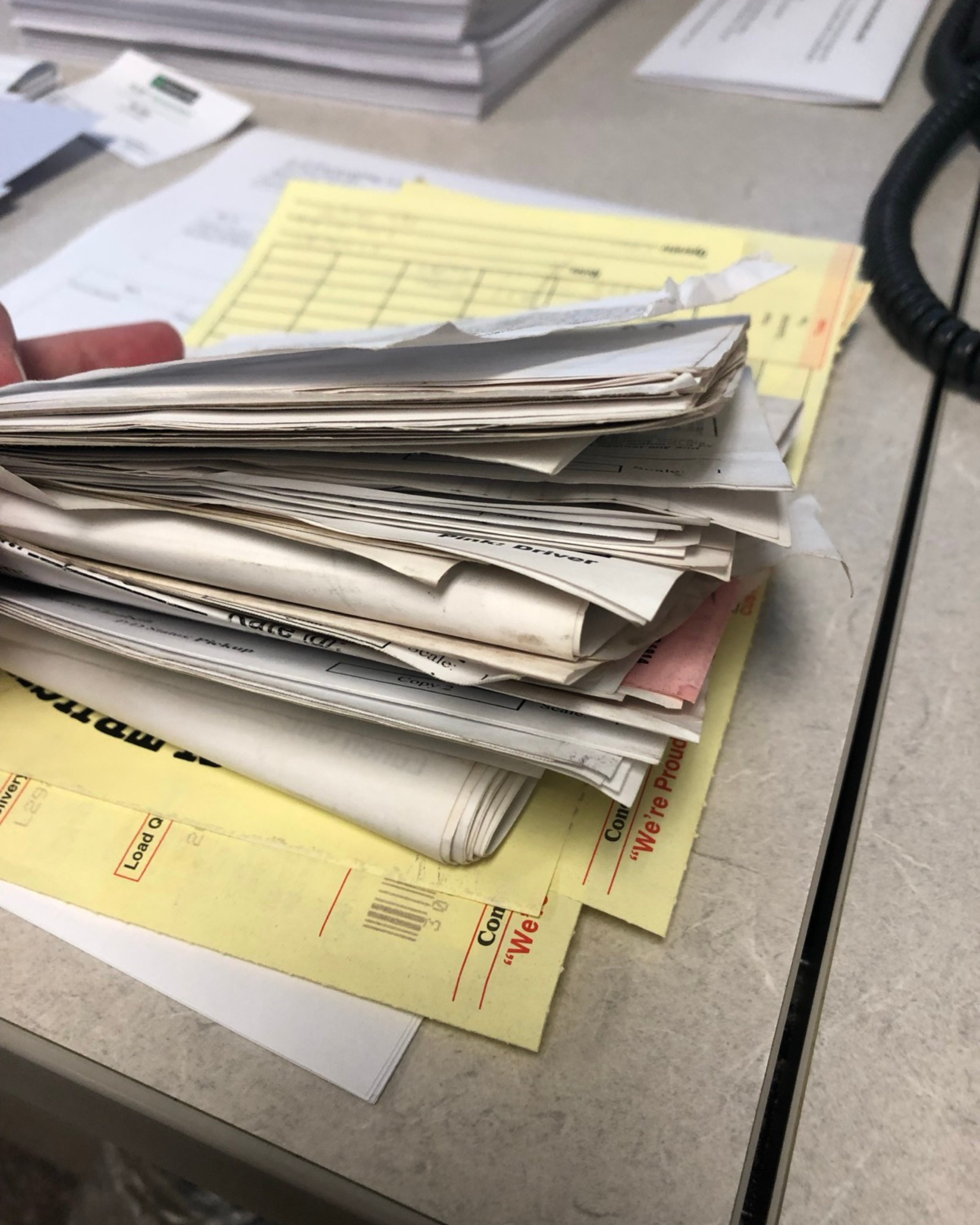
A typical day’s tickets.
Bridge
What moved Custom Concrete from one state to the next started with a better question. Not how to make the paper process faster, but how can we do this better?
The paper process was overwhelming, and it was also the standard, the way it had always been done. Entering these tickets was my job. Hundreds a month, handwritten, creased, some landing on my desk late. I keyed each one into the CRM before it went on to the next step, so I was the first to see every gap, every late ticket, every one pinned to the wrong job. The field ticket looked like paperwork. It was really the origin record for revenue, and the weakest link in the chain. Clean that one record at the moment of capture, and every step after gets easier.
Field Logistix captures the ticket data in the field, once, in real time, and sends it straight to the company's reporting layer. The drivers got a better tool. Custom Concrete built the foundation for quality.
